
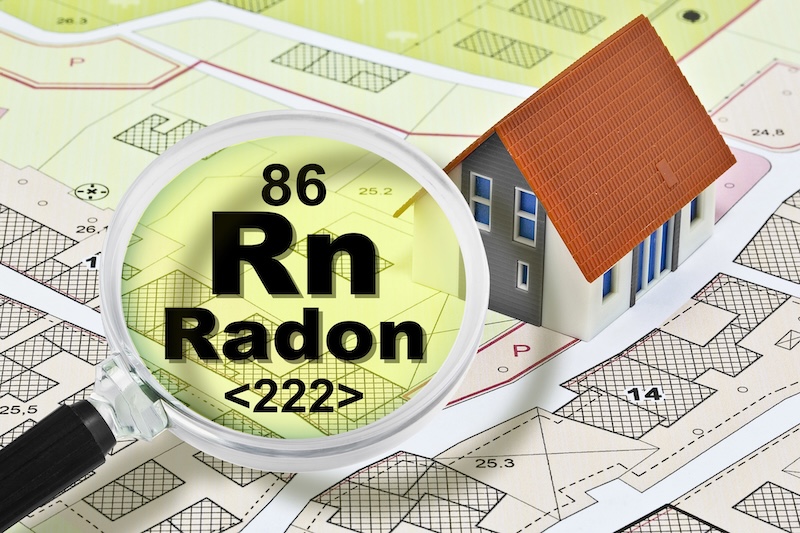
Radon testing is the one step in a real estate transaction that answers a question the home itself cannot. Radon is invisible, odorless, and entirely undetectable without measurement. It forms naturally from uranium decay in the soil beneath any home, migrates upward through the foundation, and concentrates in the living space in ways that vary from property to property and even from season to season. The only way to know whether a home has a radon problem is to test for it. Testing is most reliably performed by a licensed home inspector who follows established protocol, uses calibrated equipment, and produces a documented result that both parties in a real estate transaction can rely on.
How Professional Radon Testing Works in a Real Estate Transaction
A licensed home inspector performing radon testing places a calibrated continuous electronic monitor in the lowest livable area of the home, typically the basement or the lowest finished level, for a minimum of 48 hours under closed-house conditions. The continuous monitor records radon concentrations in real time, producing a result that reflects not just the average reading but the variation across the full testing window. Closed-house conditions ensure the test measures the home’s actual radon concentration rather than a diluted reading from open ventilation. The home inspector is responsible for establishing and documenting these conditions and verifying that nothing occurred during the testing period that would compromise the result. A result produced under properly documented closed-house conditions by a certified inspector carries weight that makes it actionable in the transaction.
Reading and Acting on Radon Testing Results
The EPA’s action level for radon is 4 picocuries per liter of air, the threshold at which mitigation is recommended. A result at or above 4 pCi/L is a documented finding that enters the negotiation, and one that is highly solvable. Sub-slab depressurization, the standard mitigation approach, involves a licensed contractor installing a pipe-and-fan system that draws radon from beneath the foundation and exhausts it above the roofline, reducing concentrations by more than 90 percent in most installations. A result above the action level is not a reason to walk away from a transaction; it’s a reason to negotiate mitigation and post-mitigation testing that confirms the result before closing.
How Radon Findings Move Through the Transaction
A radon testing result above the EPA action level becomes a documented finding that both parties address within the framework of the purchase contract, typically through negotiation over who pays for mitigation, whether mitigation occurs before or after closing, and what the post-mitigation radon testing result must confirm before the transaction proceeds. In most transactions, the finding is resolved rather than transaction-ending, because the cost of mitigation is modest relative to the purchase price, and because a home with a completed, documented mitigation system and a post-mitigation test below the action level is a home with a resolved condition rather than an open one.
Frequently Asked Questions (FAQs)
Why should radon testing be performed by a home inspector rather than a DIY kit?
A professional result produced by a certified inspector under documented closed-house conditions carries the credibility both buyers and sellers need to act on the finding. A DIY kit produces a result that may not have been conducted under appropriate conditions and lacks the documentation that makes the result defensible if questioned.
What happens if the result is right at the 4 pCi/L action level?
The EPA’s action level is a recommendation, not a regulatory requirement. A result at exactly 4 pCi/L doesn’t automatically trigger a contractual obligation, but it should trigger a conversation. Many buyers treat any result at or above the action level as a mitigation request. The EPA notes that no level of radon carries zero risk and recommends considering mitigation for levels between 2 and 4 pCi/L. A radon testing result in this range warrants discussion rather than automatic action in either direction.
How long does radon testing take in a real estate transaction?
A standard short-term radon test takes a minimum of 48 hours under closed-house conditions. The test typically runs concurrently with or immediately following the general home inspection, and results are typically available within 24-48 hours of the monitor being retrieved. The total time from placement to result delivery is typically three to four days, a window that fits within most inspection contingency periods without a separate scheduling accommodation.
Can a home with a mitigation system already installed pass radon testing?
A mitigation system confirms that elevated radon was identified and addressed at some point, not that the current level is below the action level. Fans can fail, piping can be compromised, and changes to the home’s foundation can affect system performance. Radon testing in a home with an existing system is still necessary; it verifies the system is currently functioning and producing a result below the action level, which is what the buyer actually needs rather than the assumption that a visible system equals a solved problem.
Who pays for radon testing and mitigation in a real estate transaction?
Radon testing is typically paid by the buyer as an add-on to the home inspection. The cost of mitigation, when the radon testing result triggers it, is a negotiated item; the seller may pay for installation before closing, offer a credit, or split the expense. In most transactions, the parties reach agreement because mitigation is effective, relatively affordable, and allowing the transaction to fall apart over a solvable condition benefits no one.
I Spy Inspectors provides comprehensive home inspections in Wisconsin. Contact us to schedule an appointment.